This Week From Africa 15.4.26
When everything has to serve us
We left Dakar and Gorée behind and sailed south toward the mouth of the Sine Saloum Delta.
Out there, the coast demanded our full attention. For hours we moved carefully through a busy world of fishing boats and nearly invisible nets, watching, adjusting, watching again. The sea felt crowded with work. Men in wooden pirogues moved in every direction, each one following a rhythm they knew long before we arrived. By the time we finally reached Djifère, I felt that quiet relief that comes when you can stop scanning the horizon and let the anchor drop.
Sine Saloum takes its name from the two main rivers, Saloum and Sine. Before colonial times, this region was shaped by the Serer kingdoms of the same names. Even now, those names still feel alive here, as if the land remembers things more faithfully than we do.
Djifère is a fishing village at the edge of the delta, and arriving there felt like stepping into a very different Senegal. Dakar still had banks, shops, restaurants, movement, systems. Here, life seemed to stand much closer to the ground. Hundreds of traditional pirogues rested in the shallows or at anchor, painted in colors the salt and sun had already started to soften. The market was wild, loud, and deeply alive. Fish, smoke, voices, movement, heat. Everything felt direct. Nothing felt arranged for visitors.
And yet what stayed with me most was not the market, not the poverty, not even the sheer number of boats.
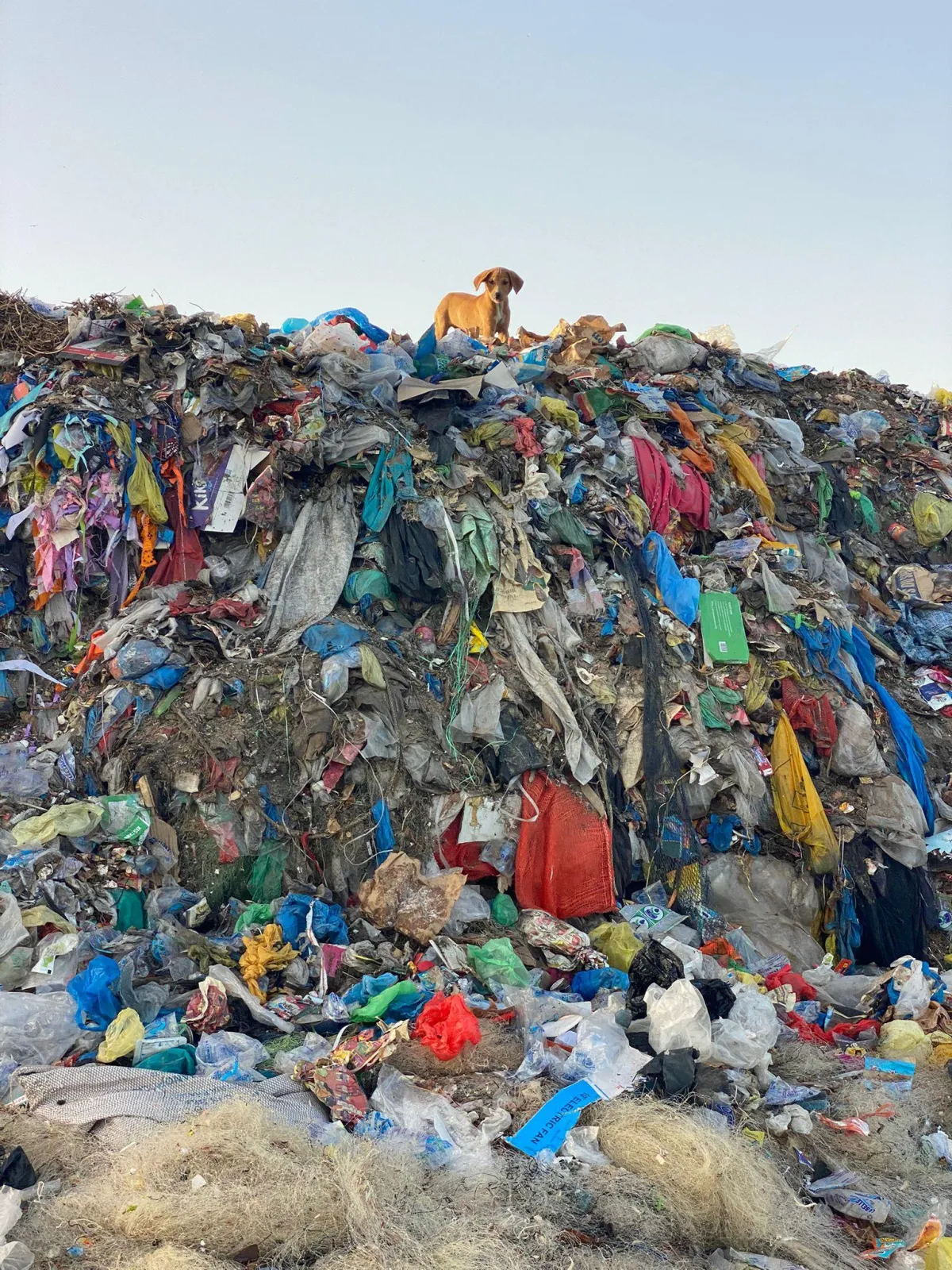
It was the rubbish.
It was everywhere. Between the houses. Between the boats. Along the paths. Piled in long tired heaps near the shoreline, where someone had at least tried to gather it into one place. But the sea kept reaching in. With every incoming wave, it pulled part of it back into the water again, as if the boundary between land and sea had given up trying to keep things separate.
I stood there for a long time watching that strange exchange. The village pushing waste toward the shore. The ocean taking it back. Nothing resolved. Nothing truly held.
And I found myself wondering when exactly we stopped belonging to the world around us and began treating it as something that had to carry whatever we no longer wanted to hold.
Maybe the harder question is whether we ever lived differently at all.
It is easy, from a Western perspective, to arrive somewhere like this, see the plastic, the visible disorder, the wounded shoreline, and make quick judgments. To look at what lies in plain sight and call that the problem. But that would let us off too easily.
Because we were the ones who taught the world how to extract without listening. Long before plastic, long before oil, we had already built entire systems on taking more than the earth could give back in the same time. We cut forests. Dug into mountains. Drew lines across land. Turned rivers, animals, people, and eventually whole societies into resources. Plastic did not begin the break in relationship. It only made it visible in a new way.
Standing there in Djifère, I could not escape the feeling that the rubbish on the shore was only the outer expression of something much older and much deeper.
The thought that everything must serve us.
The thought that everything must serve a purpose.
Once that idea settles into a culture, it does not stop with nature. It moves through everything. Through land. Through labor. Through the way we build. Through the way we measure worth. Through the way we start looking at other people. And, maybe most painfully, through the way we start looking at ourselves.
How often do we do the same thing in our own lives?
How often do we measure people by function? By usefulness? By how well they fit into the shape we already had in mind for them?
How often do we do that in leadership? At work, at home, in schools, in relationships?
And how often do we do it to ourselves? Judging our own value by output, ownership, control, efficiency, performance. As if being human were not enough. As if life only counts when it produces something.
The more I sat with this, the less it felt like an environmental reflection. It felt like a relational one.
Because maybe one of the deepest forms of imbalance begins the moment we stop seeing ourselves as part of something larger and start acting as if everything around us is there to be shaped, dominated, improved, or consumed by us. Maybe this is where so much violence begins. Not always with bad intentions, but with separation. With forgetting that we belong to the same web of life we keep trying to master.
I think this is where my work as a coach touches the same question.
Real leadership, at least the kind that interests me, does not begin with control. It begins with relationship. With listening. With respect. With the willingness to meet a person, or a place, as something with its own nature, not just its usefulness. Not something to be bent into our image, but something to be understood well enough that it can grow into its own form.
That is true for teams. For children. For partners. For clients.
And maybe it is true for landscapes too.
Not everything needs to serve us.
Some things need to be left alone.
Some things need care.
Some things need humility more than intervention.
I do not write this from any place of purity. I am part of the same world. I benefit from the same systems. I consume too much, move too easily, and forget too often. But places like Djifère confront me more honestly than comfortable places do. They strip away some of the distance. They make certain questions harder to avoid.
Not only what we are doing to the earth.
But what kind of relationship we have built with life itself.
By the time evening settled in, the light had softened over the pirogues and the market noise had begun to fade. The piles of rubbish were still there. The waves were still doing what waves do. Nothing had been solved. The village had not changed because I had looked at it. I had no answer to leave with.
Only a question that stayed.
When did we stop belonging?
And what might become possible if we learned to belong again?